
TheGrint HQ

8 minutes
Updated
October 7, 2026
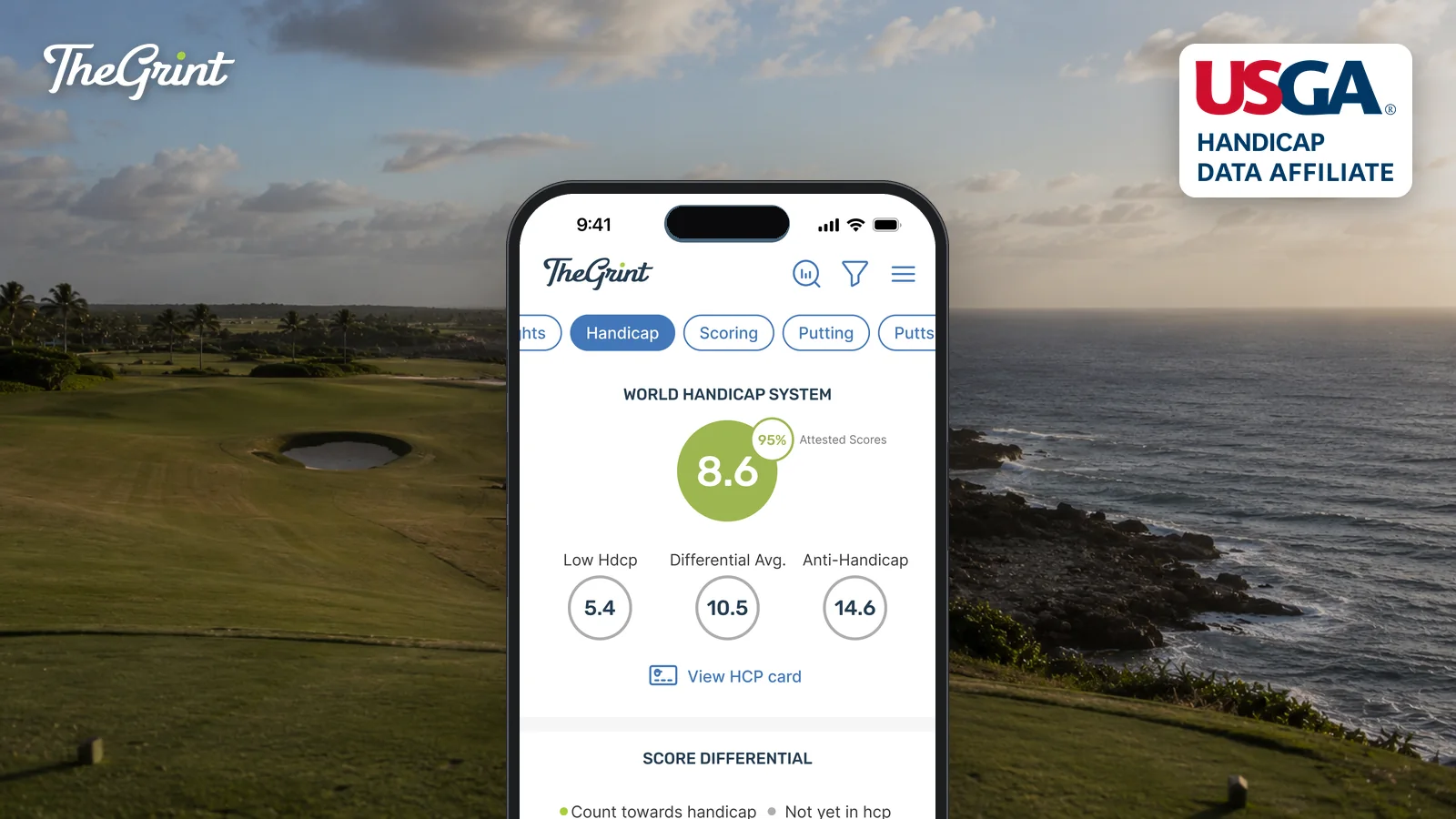
A good golf handicap is anything below the average, and the USGA® puts the average Handicap Index® at 14.0 for men and 28.8 for women at the end of 2025. A single-digit handicap places a man in the top 30 percent of golfers who keep one, and a woman in the top 5 percent.
This guide gives you the current averages, the full distribution of handicaps in the United States so you can see where yours ranks, what "good" means at each stage of your golf, and why the average golfer still scores worse than the average handicap suggests.
If you do not know your number yet, TheGrint shows every golfer an estimated handicap from the scores they enter, and U.S. golfers can buy an official USGA Handicap ID inside the app.
The average golf handicap in the United States is 14.0 for men and 28.8 for women. Those are the year-end 2025 figures on the USGA's U.S. Handicapping Statistics page, across the 3.68 million golfers who maintained a Handicap Index that year. A year earlier the USGA reported 14.2 for men and 28.7 for women, so the men's average is edging down and the women's is flat.
Two things about who is in that pool. It is 82 percent male: 3.03 million men and 0.65 million women. And it is skewed toward committed golfers. In the USGA's words, "the cohort of golfers with a Handicap Index tends to include a number of more seriously engaged golfers who also play more regularly" (USGA: Are You an Average Golfer?).
The golfer who plays a dozen rounds a year and never posts a score is not in the data. The same USGA article cites the National Golf Foundation's finding that "the average 18-hole score for men and women in the United States is about 94", which is well above what a 14 handicap would shoot on most courses.
Two useful reference points from the Rules of Handicapping definitions: a "Scratch Player" is "a player with a Handicap Index of 0.0", and a "Bogey Player" is "a player with a Handicap Index of approximately 20.0 for men and approximately 24.0 for women". Course Rating™ and Slope Rating™ are both built around those two golfers.
A good golf handicap is one below the average for your group: under 14.0 for men, under 28.8 for women. From there, each threshold means something specific.
Judge "good" against how much you play. A 20 who gets out twelve times a year is doing well. A 12 who plays every weekend with lessons has room to improve. The number is a measure of demonstrated ability, not effort, and it only moves when you post scores.
Most men sit between 10.0 and 19.9, and most women between 20.0 and 34.9. The USGA publishes the share of golfers in each five-stroke band, and the 2025 year-end figures look like this.
Men (3.03 million golfers with a Handicap Index):
Women (0.65 million golfers with a Handicap Index):
Read the table cumulatively to find your rank. A man with a 12 handicap is ahead of the 44 percent of men at 15.0 and above and of most of his own band, which puts him in roughly the top 40 percent. A woman with a 20 handicap is ahead of roughly 80 percent of women with a Handicap Index.
Figures are from the USGA's U.S. Handicapping Statistics page, year-end 2025, rounded to one decimal.

For a beginner, a good golf handicap is any official number at all, because the first one is the baseline every later improvement is measured against. The World Handicap System™ (WHS™) caps a Handicap Index at 54.0, and a Handicap Index of 30.0 or higher is common: more than four in ten women and about 3.5 percent of men with a Handicap Index sit there.
Beginners are also playing shorter rounds to get there. The USGA's 2025 Golf Scorecard found that among golfers who established a Handicap Index in 2025, "50.2% of scores posted by females and 26.7% of scores posted by males were 9-hole scores" (USGA, January 2026). Nine-hole scores count immediately toward a Handicap Index, so there is no reason to wait for a full 18 before you start posting.
You need scores from 54 holes to establish a Handicap Index, in any mix of 9- and 18-hole rounds. The steps and the cost are in how to get an official golf handicap.
Because a Handicap Index measures your potential, not your average. It is calculated from the best 8 of your most recent 20 Score Differential™ values, so it reflects your good days. A 14 handicap does not shoot 14 over par on a typical day; on a typical day that golfer shoots several strokes worse than that.
The gap also explains why the NGF's average score of about 94 and the USGA's average Handicap Index of 14.0 can both be true. The first counts every golfer who fills in a scorecard; the second counts only golfers who post scores, and then takes their best rounds.
For the arithmetic behind that, see how to calculate a golf handicap and what a golf handicap is and how it works.
You lower a golf handicap by posting every round and replacing your worst counting rounds with better ones. Only your best 8 of 20 count, so one bad round does little damage, and one good round can move the number the next morning. Beyond that, the habits that move handicaps are unglamorous.
TheGrint puts your handicap, your stats and your scorecard in one app, so you can see where you rank and what is holding the number up.
A 20 handicap matches the USGA's definition of a bogey player for men, approximately 20.0, and is better than about one in five men who hold a Handicap Index. For women, a 20 is well better than average: only about one woman in five with a Handicap Index is below 20.0. Either way, a 20 plays fair matches against anyone under the World Handicap System.
Yes. A 10 handicap is better than the men's average of 14.0 and sits at the edge of single digits, which puts a man in roughly the top 30 percent of golfers with a Handicap Index. For a woman, a 10 is exceptional: fewer than 5 percent of women with a Handicap Index are at 9.9 or better.
About 2 percent of men and under 1 percent of women with a Handicap Index are better than 0.0, according to the USGA's 2025 year-end distribution. Add golfers between 0.0 and 4.9 and the share rises to about 10 percent of men; for women, about 5 percent are in single digits or better. Scratch is rare, and a plus handicap is rarer still.
A good golf handicap for a woman is anything below the women's average of 28.8. The largest group of women sits between 25.0 and 29.9, so a woman at 20 is ahead of roughly four in five women with a Handicap Index, and a woman in single digits is in the top 5 percent.
A 15 handicap is about average for a man, one stroke above the 14.0 mean, and a strong handicap for a woman, better than close to 90 percent of women with a Handicap Index. For a man, 15 puts you in the second-largest band of golfers, 15.0 to 19.9, which holds 22 percent of all men with a handicap.
Enter a few scores in TheGrint and you will see an estimated handicap, then compare it with the numbers above. When you are ready for the official number, buy the USGA Handicap ID inside the app (U.S.) or link your GHIN® number, and post every round from the same scorecard you use for GPS, stats and games. Get started with TheGrint.
World Handicap System™, WHS™, Handicap Index®, Score Differential™, Course Handicap™, Course Rating™ and Slope Rating™ are trademarks owned or licensed by the United States Golf Association® (USGA®) and/or The R&A. GHIN® is a registered trademark of the USGA. All rights reserved.


